You're Adding a Board of Directors. Is Your Management Team Ready?
A Ukraine-based family business installed a board to provide structure as it scaled globally. Here's how the owners overcame top managers' fears and won their support.
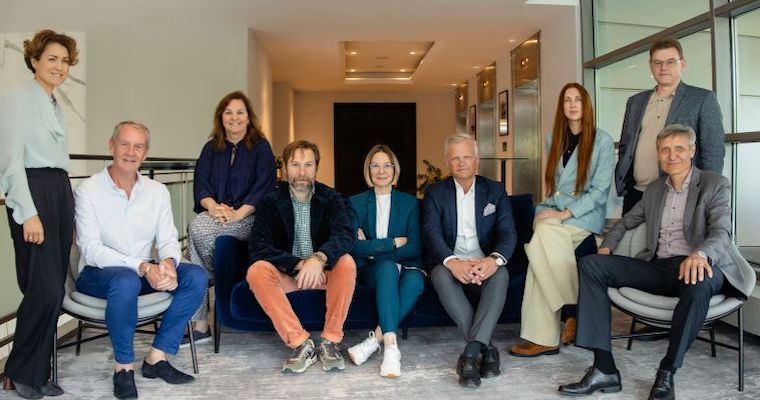
Photo: The International Board of Directors of the family-owned companies Kormotech and Enzym Group
We founded the family-owned pet food company Kormotech in 2003 in Ukraine, in the city of Lviv, together with our father, Orest Vovk, and my sister, Olena Vovk. Our dry pet food manufacturing plant was the first of its kind in the country. We operated in a market where we had to compete with large multinational corporations. To succeed, we had to act like a startup — unafraid to take risks, quick in decision-making, and willing to pursue unconventional approaches.
As Kormotech outgrew being a local business and began scaling globally, we did not lose our startup mindset or entrepreneurial drive. And it yielded results: Kormotech’s cat and dog food brands are now available in over 50 countries.
But my sister and I understand that sustainable growth requires a balance between entrepreneurial boldness and clear structure. That’s why, three years ago, we established a supervisory board for both of our family businesses — Kormotech and the biotechnology company Enzym Group, where we are both co-owners.
We had two main goals. The strategic goal was to transform from a Ukrainian company focused on export sales into a global business with a certain percentage of sales in Ukraine. The family goal was to build a structure that would facilitate passing the business on to the next generation. In this article, I will share our experience of launching a supervisory board. It may be useful for family businesses that are now on the verge of making a similar decision.
Owners: Be Honest With Yourself and Open With the Team
The prerequisite for creating a supervisory board is the owners’ readiness to share the authority to make key decisions. Taking this step may not be easy, especially if you were there from the company’s founding. Therefore, before establishing a board of directors, it’s important to ask yourself honestly: Are you ready to share power and listen to opinions that differ from your own? If not, the board will remain merely a prestige symbol rather than a part of a mature management system.
When we announced to the executive team our decision to create a supervisory board, we immediately noticed that the team perceived it not just as a structural change, but also as a potential threat. The reason is simple: in Ukraine, supervisory boards in family businesses are still uncommon, unlike in the US or Europe, where such structures are standard. The managers’ apprehension was based on the unknown — for most of them, this was a new experience. Therefore, before launching the supervisory board, we held three preparatory sessions for the executive teams of Kormotech and Enzym.
During the first session, we explained why we wanted to create the board, and the managers asked about how it would function. The most common questions were: Who writes the strategy, will board members be involved in operational activities, to whom should the executive team now report, and will the directors replace the top managers? We emphasized that the board exists to support, not to control. I illustrated this with a simple analogy — the board is like a parliament, setting rules and approving strategies, while the executive team is like a government, implementing them.
For the second session, we invited one of the future board members, who specializes in HR, communications, and reputation strategy. She shared examples of effective interactions with a board, as well as situations where processes had failed — explaining what went wrong, why, how to avoid such issues, and how to build collaboration between the executive team and the board of directors. She then facilitated a discussion with me and my sister, Olena Vovk, during which managers could ask clarifying questions. It was an open, honest conversation aimed at easing tensions and deepening understanding of the board’s role for the companies.
In the third session, we introduced the board chair and the future board members. Each of them briefly spoke about their experience, approaches to working on supervisory boards, and real examples of how a board can contribute to a company’s development.
Building Effective Collaboration Between the Board and Management
Effective collaboration requires clear rules. Here are the practices that work at Kormotech and Enzym:
- All board requests are coordinated by the CEO. This maintains the integrity of the management hierarchy and allows the CEO to control the board’s workload and the relevance of requests.
- Focus on strategy, not operational decisions. The board of directors should not perform the executive team’s work. Its role is to ask challenging questions, assess the rationale of decisions, evaluate risks, and approve key strategic steps.
- Mentorship as a development tool. Independent directors can serve as mentors for top managers — helping analyze complex cases, enhancing strategic vision, and suggesting solutions. Mentoring interactions are also coordinated with the CEO to maintain focus on priority topics.
- Principle of full transparency regarding problems. For the supervisory board to work effectively, it must see the full picture. We never hide problems or mistakes — We analyze them and turn them into lessons.
- Regular communication. A clear rhythm of meetings and reporting keeps everyone aligned. Regular strategic sessions, reporting, and discussion of mistakes allow board members to track progress and the team to receive feedback.
A New Level of Management
For family businesses, creating a board of directors is a step toward a more mature and resilient management model. The supervisory boards at Enzym and Kormotech have existed for only three years, and there is still a long journey ahead, but I am pleased to see that we are achieving the goals we set.
Today, the board validates all key decisions. For example, when we consider purchasing an asset, I first present our vision to the board of directors. We analyze the risks and can adjust the decision.
Board members’ recommendations have already altered our decisions more than once. For instance, we were building a Stage-Gate process — a system for developing new products where, at each stage, a group of managers decides whether to move forward. At Kormotech, we initially included many senior managers in this group, including myself. The directors immediately pointed out that such a number of voices would hinder the processes. They then advised me not to join the group at all, as everyone would look to my opinion as the owner, which could stifle open discussion and new ideas.
In moments like these, the value of truly independent directors becomes most evident. By independence, we do not mean formal detachment on paper, but distance — emotional, operational, and historical. These are people without a shared past with the company and without involvement in its day-to-day operations.
This distance allows them to ask uncomfortable questions and recalibrate our focus. In addition, members of our supervisory board have experience leading companies larger than Kormotech and Enzym Group, which gives them a clear view of the future scale of the business and the opportunities for growth.
We started by addressing the managers’ fears, and now the top managers themselves initiate collaboration with the directors on R&D, logistics, and HR projects. For us, this is a sign that the decision was the right one and that openness with the team has paid off. We are now preparing for the next stage — transferring roles and reducing the business’s dependence on the owner.
_______________________________________
Photo - https://drive.google.com/drive/folders/1iGpnzO7UGqOcfAksAdfK1KyRGhf_hQom?usp=sharing