Why People Risk Belongs on Every Family Business Board Agenda

Boards routinely scrutinize financial and strategic risk. But talent shortages, leadership culture problems, and succession gaps can erode long-term value just as quickly.
People risk belongs on every board’s agenda, whether public or private. Talent shortages, toxic leadership cultures, and critical skills gaps threaten long-term value creation just as surely as financial risk. A board that shapes the organization while overlooking the people within it is not fully meeting its duty of care. This article explores how private boards can apply the same analytical rigor to people strategy as they do to capital allocation — and why family enterprises, with their longer time horizons and values-driven cultures, are uniquely positioned to get this right.
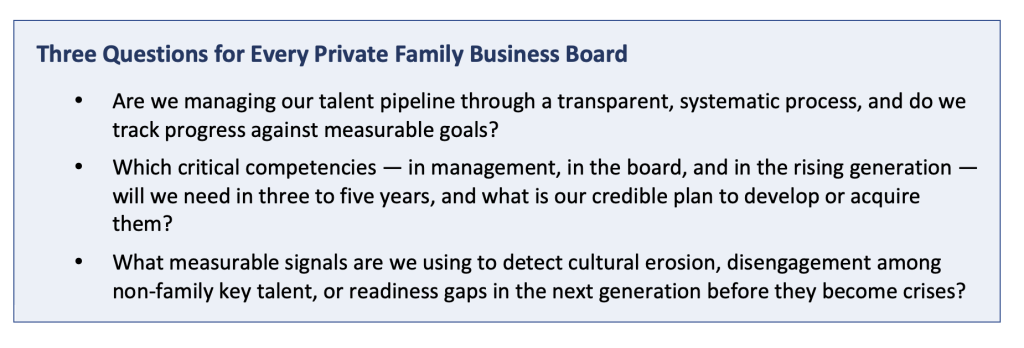
The People Risks That Are Specific to Family Enterprises
Across industries, ‘human capital’ has become one of the most significant risk factors in enterprise risk management. But while all businesses face people risk, multigenerational family enterprises face a distinctive set of challenges that private boards must understand and name explicitly:
- The “family premium” problem: High-performing non-family managers often leave when they perceive that the ceiling above them is glass — reserved for family members regardless of merit. Losing this layer of talent is one of the most damaging and least-discussed risks in family enterprise.
- Founder shadow and leadership culture: In second- or third-generation enterprises, the cultural norms established by the founder can calcify into rigidity, stifling the adaptability that survival requires. A board that never challenges the prevailing culture is not governing; it is spectating.
- Entitlement and readiness gaps in the rising generation: When family members enter the business without adequate preparation, they can demotivate the non-family workforce and create skills gaps in roles that should be filled on merit.
- Concentration risk in key relationships: In closely held enterprises, critical client, supplier, and institutional relationships are often embedded in individual people. When those people leave, the value walks out with them.
- Succession planning beyond the C-suite: Family enterprises often invest heavily in CEO succession while neglecting the deeper talent bench. A business that loses its CFO, its head of R&D, or its leading sales director can be as damaged as one that loses its chief executive.
The Board’s Evolving Mandate: Stewardship, Strategy – and People
The board of a multigenerational family enterprise carries a mandate that is somewhat broader than that of a publicly listed company. Beyond strategy, risk and financial oversight, succession, and increasing shareholder value, the family enterprise board also the obligation to steward both business assets and the family’s relationship with those assets across time.
Family enterprise boards that focus on strategy and shaping organizational structure while overlooking the people within it are not meeting their full obligations. In today’s knowledge economy, the human factor has become the decisive variable at every level of the organization. When a growth strategy stalls because the middle management layer lacks the digital competencies to execute it, that is a governance failure. When key non-family leaders leave because the culture has become insular or the family dynamic has spilled over into the workplace, enterprise value is directly impaired. Talent shortages, skills gaps, and leadership culture failures are not HR problems; they are board-level failures. People risks are today inextricably linked with the board’s duty of care.
The board is accountable for ensuring that the human dimension of strategy is governed with the same rigor as its financial one. HR executes; the board sets standards, asks hard questions, and holds the organization accountable for the answers.
'Noses In, Fingers Out’ — Reimagined for Private Boards
The “noses in, fingers out” principle, or the idea that boards set direction and ask hard questions without meddling in operations, is well established. In family businesses, however, it is frequently violated in both directions: either the family board is too deferential to family-member management, or it over-reaches into daily operations because the boundaries between ownership, governance, and management were never clearly drawn.
Effective governance means applying rigorous process thinking to people topics without crossing into micromanagement. The right questions are not operational: “What does our hiring process look like?” The right questions are strategic: “By what standards are we managing our talent pipeline, and what evidence do we have that it is working?”
Family enterprise boards should also hold themselves accountable for one process that is uniquely theirs: the development pipeline for the next generation of family leadership, both in management and on the board level. This requires honesty about readiness, structured entry criteria, and the willingness to place family members in roles where they can genuinely grow — not roles designed to protect their status.
Lastly, the best talent – both family and non-family alike – should be treated as strategic stakeholders. High-potential non-family managers, in particular, need visible signals that their contribution is seen, valued, and has a future. This does not mean bypassing management; it means creating deliberate moments of connection: strategy sessions, mentoring from board members, or structured “Board Meets Talent” conversations.
From Gut Feel to Governance: People Analytics for Private Boards
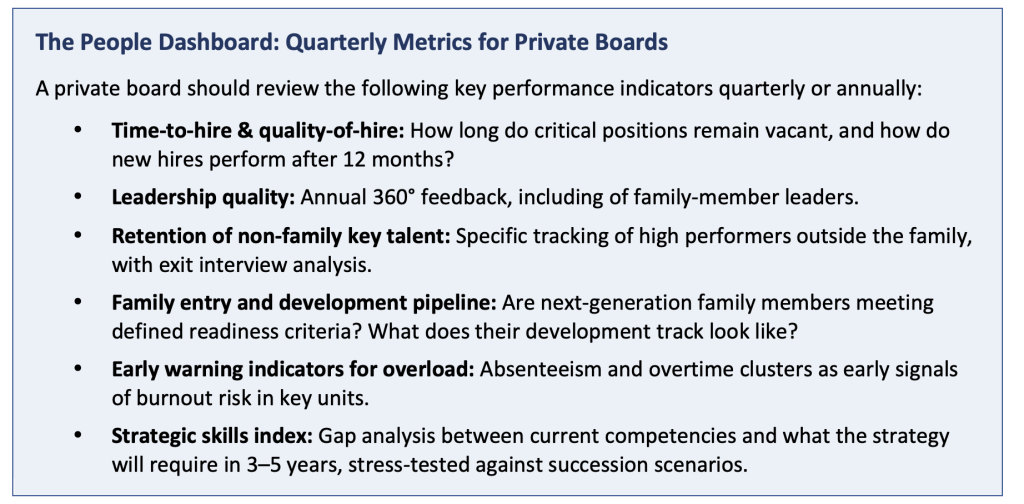
Many private boards still rely on informal feedback loops, annual surveys, and the personal impressions of family-member managers to assess people health. Businesses where trust and loyalty are valued can be reluctant to quantify what feels personal. But the shift from gut feel to structured metrics is a discipline that actually protects the culture. Predictive analytics -- that is, data that anticipate where engagement is falling, where skills gaps are emerging, and where burnout risk is clustering -- allows the board to intervene before problems become crises.
For private boards meeting quarterly, the question should not be “How is the team doing?” answered informally over dinner. It should be: “What do the data tell us about the health of our people systems, and where do we need to act?”
Conclusion: People Strategy as a Multigenerational Imperative
Family enterprises have always understood, intuitively, that people matter: the founder who knows every employee by name, the culture that feels like family, the loyalty that outlasts market cycles.
The private board of a multigenerational family enterprise is uniquely placed to lead this work through a people strategy that is both rigorous and deeply human. What it requires is the willingness to move from instinct to infrastructure: to treat people risk with the same analytical seriousness as financial risk, and to build the metrics, processes, and board capabilities that make that possible. A private board that invests in its top talent signals something powerful to the whole organization: that people are not just a cost to be managed but the very mechanism of intergenerational continuity.

Head of Governance Practice at Generation 6 | Family Enterprise Advisors / Lucerne School of Business / Affiliated Researcher at Jönköping University (CeFEO) and Witten/Herdecke University
View Profile