How Family Offices Can Turn Impact Investments Into Measurable Results

Active ownership, clear goals, and close relationships with entrepreneurs can help investments deliver social and environmental impact.
EDITOR'S NOTE: This article was produced in partnership with Family Business Review, a leading journal in the field of family business, as part of our mission to bring research-proven insights and practical advice to our readers.
Single-family offices (organizations that manage and invest one family's wealth) are a substantial and growing source of investment capital. Deloitte estimated that 8,030 operated worldwide in 2024, up from roughly 6,130 in 2019, collectively managing about US$3.1 trillion (Deloitte, 2024). In UBS’s 2025 survey of 317 family offices, about 26% said they currently considered sustainability and/or impact through selected investments, while 20% did so through direct investments in green technology or other sustainability-related ventures (UBS Global Family Office Report, 2025).
But deciding to invest for impact is only the beginning. The harder question is what happens after the investment: How does a family office help a portfolio company (a business it has invested in) turn a broad impact ambition into real results?
This problem matters because family offices are different from many other investors. They often invest their own family's money, can take a longer view, and may build close relationships with founders. At the same time, they also care about control, family reputation, legacy, and passing wealth to the next generation. These qualities can support impact, but they can also make families cautious or slow to change, delaying a shift toward impact investments or limiting how boldly they support change after investing.
We expected that family values and priorities, socio-emotional wealth, and longtime horizons would shape how family offices work with impact-oriented portfolio companies. Based on earlier impact investing research, we also expected a gap between stating an impact goal and showing that the investment contributed to it, because impact can be difficult to define, measure, and attribute to one investor. What we did not know was which day-to-day practices -- such as selecting investments, setting expectations, governing companies, measuring impact, and working with founders after investing -- would close that gap, or why family offices with similar ambitions would act so differently.
What We Studied
Our research looked at nine single-family offices and eight impact-oriented companies from their investment portfolio across Sweden, Norway, the Netherlands, and Germany. The sample focused on family offices that were active in impact investing and had high or relatively high family involvement.
We interviewed 21 people: seven active family members, six non-family managers working in family offices, and eight founders or executives from portfolio companies. Interviews lasted 33 to 66 minutes, with an average of 51 minutes. We also leveraged company information and informal conversations to understand each case. Looking at both sides of the relationship was important, as an investor may believe it is helping while a founder may experience that help very differently.
We asked how impact goals were chosen, how investments were screened and governed, how family offices worked with portfolio companies after investing, what made the work difficult, and what helped turn intentions into outcomes.
What We Found
We found four main ways family offices try to turn impact intentions into action:
- Choosing for value alignment. Before investing, they look for founders and teams whose values and purpose fit the family's goals.
- Building impact into the investment. They use due diligence, impact models, agreed targets, financing terms, board roles, or operating positions to protect the impact purpose.
- Acting as active owners. They stay involved through boards, frequent meetings, advice, networks, and sometimes direct management support. This can add expertise, resources, and alignment, but it can become overreach if the family restricts the founder's independence or becomes too managerial.
- Investing in the relationship. They use trust, loyalty, personal contact, and a long-term commitment to work through difficult periods with entrepreneurs.
We also saw that three barriers repeatedly got in the way:
- Measurement problems. Families struggled to define impact, select useful measures, and show what changed because of the investment.
- Unclear added value. Leaders of portfolio companies did not always see how the family office contributed beyond providing capital.
- Family inertia. Fear of losing money, damaging the family name, or moving away from the path that created the family's wealth could limit bolder investments or delay changes to existing holdings. This caution was often tied to tension between generations.
Two factors helped overcome these barriers. First, family ownership provided patient capital: Families can think in generations, support experimentation, and stay invested through setbacks. This gave portfolio companies time to test approaches and pursue impact without pressure for a quick financial return. Second, reducing the distance between investor and company improved learning and alignment, helped the family office identify where it can contribute, and connected the intended impact to day-to-day decisions.
We were especially surprised that similar family qualities can help or hinder impact. Control can protect the mission or restrict a founder. Close relationships can build trust or prevent difficult conversations. A strong legacy can inspire long-term action or create fear of change. Family ownership is therefore not automatically an advantage; it becomes an advantage when it is used deliberately.
Takeaways for Family Firms
There is no single best model. The right approach depends mainly on two choices: how much ownership and control the family office has, and whether its approach is formal or relationship-based. These choices create four useful patterns:
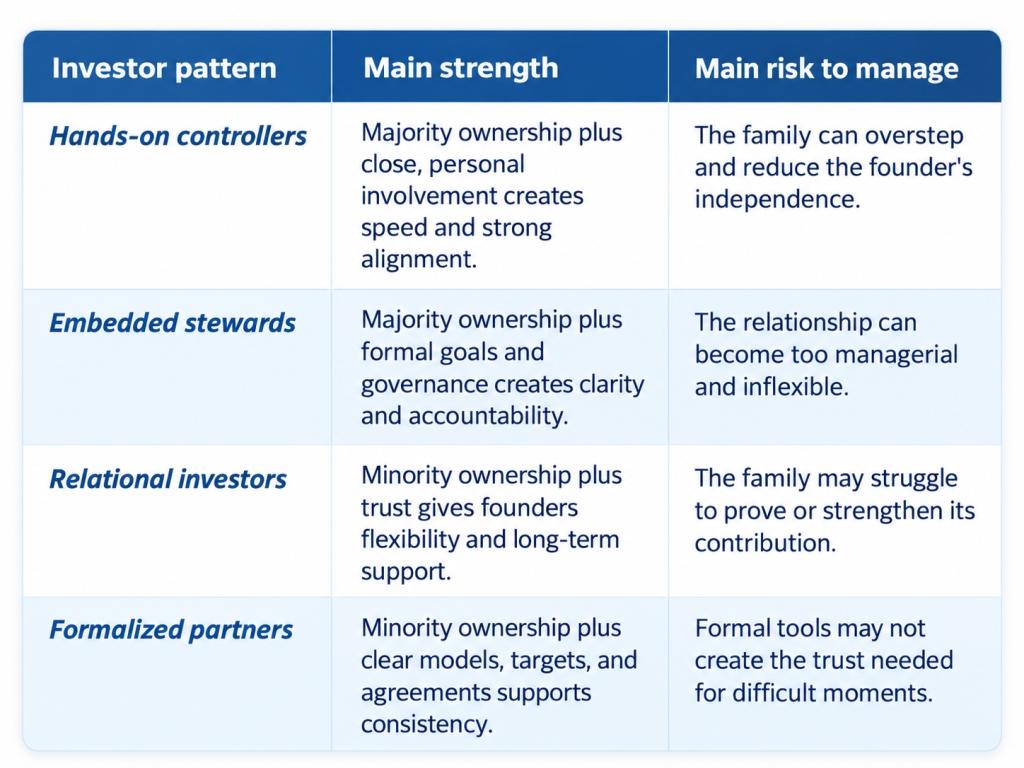
These patterns are not fixed labels. A family office can combine them or change its approach over time. The practical point is to make the chosen approach explicit to family members, office staff, and portfolio-company leaders, so they share expectations about what each will do and why. Ownership, governance, measurement, and the style of working with founders should support the same impact ambition. They can make the approach explicit through investment criteria, agreements, board roles, impact targets, and meeting routines.
A practical starting point is to review each impact investment using the following questions:
- Define the outcome. What specific social or environmental change do we want, for whom, and over what period?
- Check the people and values. Do the family's priorities and the founders' goals truly match before money is committed?
- Choose an ownership logic. Will we lead through control, formal agreements, trusted relationships, or a clear combination?
- Use a small set of useful measures. Agree on a few indicators that guide decisions. Do not let a search for perfect data delay action.
- Agree on involvement. Clarify board roles, meeting frequency, decision rights, and where the founder needs independence.
- Name the added value. State what the family office will provide beyond money, such as patient capital, expertise, contacts, credibility, or operational help.
- Review family barriers openly. Discuss whether reputation concerns, attachment to the past, or generational differences are blocking the impact ambition.
- Revisit the fit. As the company grows, check whether the current balance of trust, control, and formal accountability still works.
The most surprising message may be that good intentions, patient money, and friendly relationships are not enough. Family offices need to connect their values to concrete ownership practices while remaining honest about what they actually add. The strongest approach combines purpose, accountability, and respect for the entrepreneur.
Explore the Research
Nordqvist, M., Mismetti, M., Holmberg, F., & Schwab, L. (2026). How Single-Family Offices Translate Impact Intentions to Desired Outcomes in Portfolio Companies. Family Business Review, June 2026

Professor, Center Director / House of Innovation / Stockholm School of Economics
View Profile