Cooperating with Competitors is Good Business in Japan
Japanese family businesses are encouraged to help one another for the benefit of their shared customers and their community. It has helped them survive setbacks and thrive.
Family businesses are a driving force of regional development, and those that’ve been operating for several generations develop a close relationship with the local community. Internationalization may weaken these relationships, but in times of crisis, having an anchor can be particularly helpful.
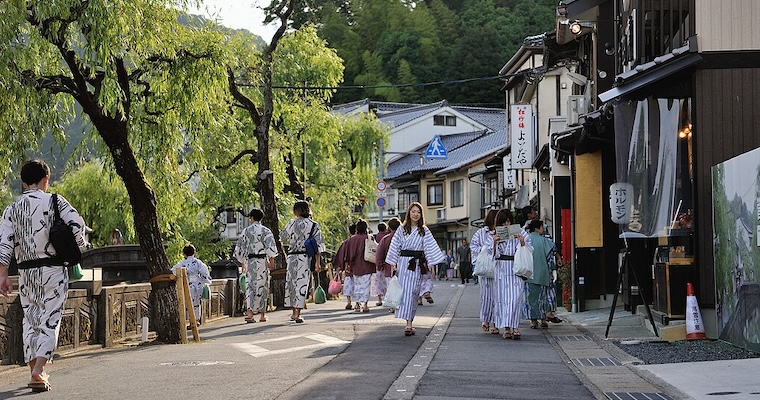
Our research in Kinosaki, Japan, showed how family businesses with deep roots in the community have depended upon one another in good times and bad. In Kinosaki, the business community centers around the local hot springs and the traditional inns (called ryokan) that house many visitors to the springs. Because of their presence in the community for many generations (the oldest dates back to 717), innkeepers feel a sense of stewardship towards the hot springs and an obligation to protect them. This requires avoiding moves that prioritize personal advantage over protecting Kinosaki’s entire business ecosystem.
This is called “Commoning,” a sense of joint responsibility for the community's well-being. While fierce competition among businesses is the norm in many Western nations, Japan’s approach brings its own benefits and is worth examining, especially in an age of increasing social isolation. It has helped all of Kinosaki’s businesses prosper by creating a welcoming atmosphere that makes visitors feel at home, boosting tourism.
The Mindset That Makes This Happen
Japan is one of the countries with the most long-lived family businesses, with several hundred over 200 years old and 20 over 1,000 years old. Japan’s long-standing companies have a profound sense of gratitude towards the local environment, which has demonstrably influenced business decisions.
Many geographical, historical, and cultural factors have shaped these attitudes. One is that Japan, like other island nations, is vulnerable to natural disasters such as earthquakes, volcanic eruptions, typhoons, and others. Businesses that have suffered during these disasters have always received help from others who escaped harm. Other factors include the Shinto tradition, which holds that people become deities after death, and the Buddhist concept of a personal sense of obligation or debt of gratitude, called “ON” in Japanese, which extends not only to family members but also to the community.
The businesses consider the needs of the local community in their decision-making and actions. “Good for the seller, good for buyer, good for the world” (sanpō yoshi in Japanese) is a “triple win” philosophy: fair profit for the entrepreneur, satisfactory value for the customer, and a contribution to the well-being of the surrounding environment need to be in a balance favourable to all parties. It is used to explain why Japanese companies often limit “competitive aggressiveness” in their activities.
Kinosaki itself gained resilience and a profound respect for the benefits of working together after it was levelled in a 1925 earthquake. The community rebuilt itself to evoke the feeling of “a single, jointly run inn,” where all businesses feel connected to one another. The streets along the river were widened to form a promenade, for which all residents made ten percent of their land available. The operators of the ryokan inns, restaurants, and souvenir stores agreed to this “town-wide business strategy,” which ensured that income was shared among the town's (family) businesses, benefiting all residents from tourism. This philosophy of “doing business together for the good of all” remains in effect to this day.
Cooperative Behavior at Work in Kinosaki
Kinosaki’s ryokan can also be traced back many generations: the oldest dates to 717. The innkeepers, many of whom grew up in the area, are longtime acquaintances who’ve worked together on many projects and initiatives.
The hot spring water from Kinosaki’s seven springs was made available in public baths. Private use was not permitted, despite its short-term benefits to individuals, to minimize the risk that the springs could run dry. This would have significantly damaged the village's long-term economic basis: accommodating pilgrims and bathers. Instead, the local community agreed on the everyday use of natural resources at public bathhouses. Since the early 1820s, the innkeepers have pledged to protect the hot springs, prioritizing the economic well-being of the entire community over their personal gain.
One ryokan owner sought a competitive advantage by tapping a spring, making it exclusively available to his guests. However, this jeopardized the flow of spring water to the seven public baths, which had previously been kept in balance. He eventually realized that the benefits of belonging to this sustainable community outweighed any individual benefit from acting selfishly, and he stopped tapping the water supply.
Rescuing the Competition
The owners of ryokan such as Koman (founded in 717), Nishimuraya (founded in 1856), Mikiya (founded in 1580), Yamamotoya (founded in the 1670s), and Yutōya (founded in 1688) could easily be seen as “competitors.” However, in times of crisis, their commitment to one another overrides any impulse to capitalize on another’s setback.
In 1993, the owner of Mikiya passed away. His son was only 12 years old at the time, so his widow took care of the inn. She was familiar with the service but had limited experience in financial matters. Even during his father's lifetime, business at the Mikiya had not been going well, and his mother had barely managed to manage the inn.
After completing his economics degree, the son took over and sought loans to renovate the Mikiya, but the banks demanded a business plan and a guarantee from him. The earnings prospects were insufficient, and repaying the loans was considered risky. In this situation, it would have been easy for a competitor to take over the traditional company. Instead, something else happened: the innkeeper of Koman helped the young successor to obtain the necessary loans to continue running Mikiya; the elder innkeeper gave his support to the young son of another innkeeper. He did so with the consent of the other innkeepers of long-established ryokans. The late father had been a schoolmate and good friend, a personal connection that the other ryokan owners also knew and respected. The reasoning was unanimous: "The Mikiya belongs to the history of Kinosaki like Kinosaki belongs to the Mikiya.” This sentence emerged from the house's history and development into its motto[1].
Now that the banks had granted the necessary loans thanks to the support of the other long-established ryokan, the successor took steps to make Mikiya profitable again. He also introduced new marketing plans that helped attract more visitors to the community, benefiting his fellow innkeepers and other businesses in town.
Lessons for Family Businesses
Family firms everywhere can learn from the innkeepers of Kinosaki, even if they don’t operate in island nations or practice Shinto or Buddhism. Here are some things to think about:
- For family firms that prefer to maintain a strong presence in their original location, engaging in activities that create shared community memories can be beneficial. This could include cooperating with local tourist offices to provide basic education on local history or tourist attractions; implementing a joint information system about the availability of accommodation in town; or jointly organizing welcome events for new apprentices.
- Find ways to work with other businesses in the community, including your competitors, on initiatives that make the community as a whole stronger. You might join or lead local business associations or task forces that market the community to visitors; be part of a volunteer firefighting group or security measures for traffic; or help organize local festivities such as sports competitions or seasonal markets. Even jointly working with your competitors on crowdfunding that helps the community or someone in need may be an option.
- Such shared memories need not be created from a single family business alone; joining forces beyond business activities may contribute to a sustainable network that helps the family, the family business, the employees, and the customers to establish a more trustworthy relationship in times of fading social interconnectivity.
- A cooperative behavior with otherwise competitive businesses may increase the attractiveness of the community and thus contribute to its overall well-being.
- In this sense, the point is not to identify a natural resource within a specific community to establish a management of the commons, but to increase efforts among family business leaders to develop social relationships in the sense of neighborhood commons in a specific place.
By engaging in such shared activities, family firm leaders can contribute to the development of a community spirit that extends beyond business.
Learn More
Download our complete study from the link above.
[1] Interview of 12. April 2024, see also http://kinosaki-mikiya.jp/; or https://visitkinosaki.com/. It was not revealed whether deficiency guarantees were issued.
Photo of Kinosaki by Mypom9 - Own work, CC BY-SA 4.0, https://commons.wikimedia.org/w/index.php?curid=73812107

Dr. phil. / Department of Econoics, Management and Society / Witten Institute for Family Business (WIFU)
View Profile


Professor / Management and Dynamics of Family Business / Witten/Herdecke University
View Profile