What Is WISE Analysis, and How Does It Improve on SWOT?

WISE replaces SWOT's opportunities and threats with external enablers and inhibitors, helping companies develop strategies based on their unique strengths and weaknesses.
One of the oldest and most widely adopted tools for strategic analysis is the SWOT framework (Puyt et al., 2023). Its popularity is understandable, as it is simple and intuitive.
Yet, the more I have used it as instructor and advisor, the more I have become uncomfortable with one of its underlying assumptions: Why do we consider opportunities to be external factors? Does an opportunity really exist independently of the characteristics of the firm that may exploit it?
In entrepreneurship research, Per Davidsson (2015) questioned the ambiguity surrounding the concept of entrepreneurial opportunity. He argued that scholars often used the same term to describe external changes, new venture ideas, and entrepreneurs' beliefs about their prospects.
To address this ambiguity, Davidsson introduced the concept of external enablers, subsequently developed with some colleagues (Davidsson et al., 2020). External enablers are environmental changes -- such as regulatory reforms, technological innovations, demographic shifts or social evolutions that can facilitate entrepreneurial activities without necessarily constituting opportunities themselves.
Although this perspective was originally developed in the realm of new venture creation, I believe its underlying logic is also relevant to established firms. In addition, I may extend the terminology of Davidsson by labelling external inhibitors the counterparts of external enablers.
From SWOT Analysis to WISE Analysis
In strategic analysis, I suggest keeping the familiar and powerful distinction between internal and external factors, as well as the distinction between favorable and unfavorable conditions. I would also keep on talking about “Strengths” and “Weaknesses,” but I would replace the terms “Opportunities” and “Threats” with “Enablers” and “Inhibitors”.
Thus, I suggest replacing the acronym “SWOT” with “WISE”: Weaknesses, Inhibitors, Strengths, and Enablers.
It may seem like a small change, but the language of management frameworks influences how we think, and the way we think influences the decisions we make. The difference between SWOT and WISE goes beyond terminology.
In SWOT, opportunities are treated as input to strategic analysis; in WISE, they become its output. Rather than identifying opportunities at the beginning, managers may first examine the strengths and weaknesses alongside external enablers and inhibitors. Only then could they consider how these elements interact to generate strategic opportunities as potential courses of action.
Opportunities belong to a strategic management phase that comes after the strategic analysis. It’s the phase of strategy formulation, when decisionmakers identify the strategic options available and evaluate which ones are worthy of selection.
An Illustrative Example
Imagine two large food companies operating in 2026: The first specializes in dairy products and nutritional foods, while the second is a leading manufacturer of traditional snacks and confectionery products. Both face the same consumer trend: growing demand for high-protein foods, driven by increasing attention to fitness and nutrition.
A conventional SWOT analysis might classify this trend as an opportunity for the first company and a threat for the second. The WISE analysis offers a different perspective: The trend represents an external enabler for the first company's existing dairy and nutrition businesses, while potentially acting as an inhibitor for the second company's traditional product portfolio.
Then, by considering their respective strengths and weaknesses, both companies may identify strategic opportunities. The first could leverage its expertise in dairy processing and nutrition to develop new high-protein products. The second could leverage its strong brands, extensive distribution network, and product development capabilities to enter the growing market for protein-enriched snacks.
Thus, even an external inhibitor can help companies identify new strategic opportunities: WISE distinguishes the effects of external changes from the opportunities that firms may identify in response to them. In addition, it uses the term “opportunity” in a proper way.
A Wiser Way to Think About Opportunities
SWOT has served generations of managers and entrepreneurs well. Unlike some scholars (Hill & Westbrook, 1997), I don't believe in scrapping this framework. However, I believe we can improve it by reconsidering what belongs in its two external quadrants.
There we find external enablers and inhibitors, rather than opportunities and threats. Opportunities, instead, emerge from the interaction between those external changes and the characteristics of firms.
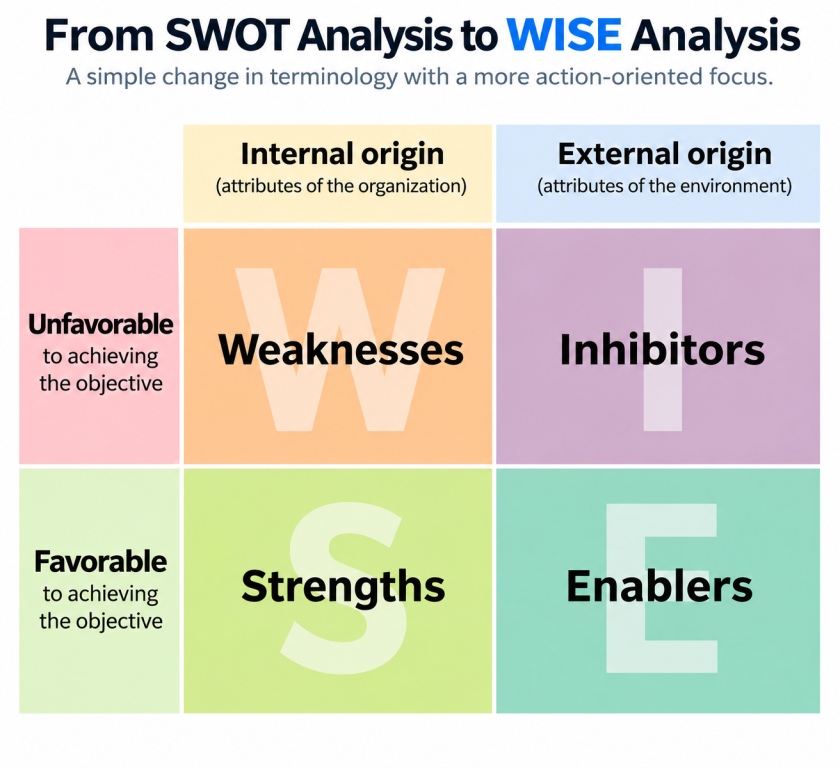
The next time we conduct a strategic analysis, we should resist the temptation to immediately identify opportunities. Instead, we should first understand what is changing around the firm (enablers and inhibitors), what the firm can do or not (strengths and weaknesses), and how they relate.
It is time to move from SWOT to WISE, not because opportunities matter less, but because they matter more: They are the result of strategic analysis.
References
Davidsson, P. (2015). Entrepreneurial opportunities and the entrepreneurship nexus: A re-conceptualization. Journal of Business Venturing, 30(5), 674–695.
Davidsson, P., Recker, J., & von Briel, F. (2020). External enablement of new venture creation: A framework. Academy of Management Perspectives, 34(3), 311–332.
Hill, T., & Westbrook, R. (1997). SWOT analysis: It's time for a product recall. Long Range Planning, 30(1), 46–52.
Puyt, R. W., Lie, F. B., & Wilderom, C. P. M. (2023). The origins of SWOT analysis. Long Range Planning, 56(3), 102304.

Professor / FABULA (FAmily BUsiness LAb) / Cattaneo University - LIUC
View Profile